In this lesson we discuss the shape of a graph, in particular concavity, as it applies to modeling. We also use absolute value to describe distance, and solve absolute value equations and inequalities.
If you prefer to concentrate on absolute value, you could assign Activity 1 as homework. Then give a short lesson on using the notation \(\abs{x-a}=b\) to discuss distance. If you wish to cover measurement error, you could also do that now.
Activity5.6.1.Using the Basic Functions.
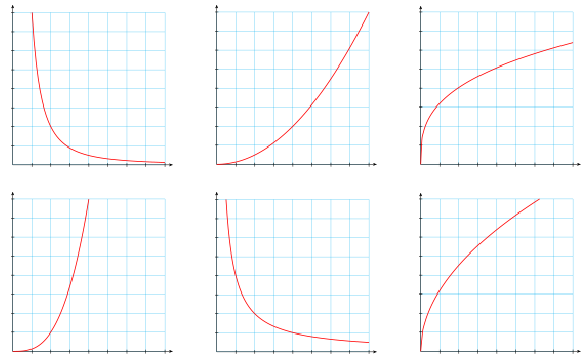
Here are some situations that can be modeled by variations of the basic functions. Match each situation with a function from the list below, and with the appropriate graph. Write your function with the variables in the description, and answer any questions about the model.
The time, \(t\text{,}\) it takes to travel a certain distance, \(d\text{,}\) is inversely proportional to the speed, \(r\text{,}\) at which you travel. For example, to travel 400 miles at an average speed of 50 miles per hour will take 8 hours.
Write a formula for \(t\) as a function of \(r\text{.}\)
Choose the appropriate graph, and label the axes.
If you double your average speed, what happens to the travel time?
The distance, \(D\text{,}\) needed to stop a car is proportional to the square of its velocity, \(v\text{.}\) A car traveling at 50 miles per hour needs about 170 feet to stop.
Write a formula for \(D\) as a function of \(v\text{.}\)
Choose the appropriate graph, and label the axes.
What happens to the stopping distance if the velocity of the car is doubled?
The intensity, \(I\text{,}\) of sound is proportional to the reciprocal of the square of the distance, \(d\text{,}\) from its source. In a certain auditorium, the sound intensity 6 meters from the stage is 100 watts per square meter.
Write a formula for \(I\) as a function of \(d\text{.}\)
Choose the appropriate graph, and label the axes.
What happens to the sound intensity if the distance from the stage is doubled?
The amount of energy, \(E\text{,}\) generated by a windmill is proportional to the cube of the wind speed, \(v\text{.}\) When the wind speed is 8 meters per second, the windmill generates 314 watts per square meter of energy.
Write a formula for \(E\) as a function of \(v\text{.}\)
Choose the appropriate graph, and label the axes.
What happens to the energy generated if the wind speed is doubled?
The speed, \(S\text{,}\) of a tsunami is proportional to the square root of the depth, \(D\text{,}\) of the ocean at that point. At a depth of 25 meters, a tsunami travels at 15.65 meters per second.
Write a formula for \(S\) as a function of \(D\text{.}\)
Choose the appropriate graph, and label the axes.
What happens to the speed of the tsunami if the depth of the ocean is doubled?
The height, \(h\text{,}\) of water in a conical storage tank is proportional to the cube root of the volume, \(V\text{,}\) of the water. If you pour 8 cubic feet of water into the tank, the water will reach a height of 3 feet.
Write a formula for \(h\) as a function of \(V\text{.}\)
Choose the appropriate graph, and label the axes.
What happens to the height of the water if you double the volume of water you pour in?
Activity5.6.2.Solving Absolute Value Equations.
We’ll solve the equation
\begin{equation*}
\abs{x-3} = 5
\end{equation*}
in three different ways: with a graph, wth a number line, and with algebra.
Solution by graphing
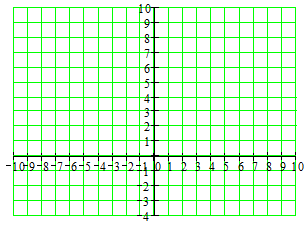
Graph \(y=\abs{x-3}\) with technology, and copy the graph onto the grid below.
Sketch the horizontal line \(y=5\) on your graph.
Find the points on the graph of \(y=\abs{x-3}\) that have \(y=5\text{.}\) (How many points are there?) What are the \(x\)-coordinates of those two points? These are the solutions.
Next we’ll use a number line to solve the equation.
Translate the equation \(\abs{x-3} = 5\) into a sentence about distance.
Locate 3 on the number line below, and find two points at a distance of 5 units from 3.
What are the \(x\)-coordinates of those two points?
Finally, we’ll use algebra to sove the equation. Recall the definition of absolute value:
Solve the equation \(\abs{x+6} = 2\) in three different ways:
By graphing \(y=\abs{x+6}\text{.}\)
By using a number line.
By using algebra.
Activity5.6.3.Solving Absolute Value Inequalities.
We’ll solve the inequality
\begin{equation*}
\abs{x-3} \lt 5
\end{equation*}
in three different ways: with a graph, wth a number line, and with algebra.
Solution by graphing
Refer to your graph of \(y=\abs{x-3}\) in Activity 2, and shade the points on the graph that have \(y \lt 5\text{.}\)
Now shade the portion of the \(x\)-axis that corresponds to those points. (Are the endpoints included in the solution set?) Write your answer with interval notation.
Now use the graph to solve \(\abs{x-3} \gt 5\text{.}\) Note that the solution set consists of two intervals.
Write your answer with interval notation.
Next, we’ll use a number line.
Translate the inequality \(\abs{x-3} \lt 5\) into a sentence about distance.
Locate 3 on the number line below, and shade the points closer than 5 units from 3.
Write your answer with interval notation.
Now use the number line to solve \(\abs{x-3} \gt 5\text{.}\)
Shade the points farther than 5 units from 3. Write your answer with interval notation.
Finally, we’ll solve the inequality \(\abs{x-3} \lt 5\) with algebra.
This absolute value inequality is equivalent to the compound inequality \(-5 \lt x-3 \lt 5\text{.}\) Solve the inequality and verify that you get the same solution as before.
Now we’ll solve \(\abs{x-3} \gt 5\text{.}\) This absolute value inequality is equivalent to the compound inequality
Solve the inequality and verify that you get the same solution as before.
Subsection5.6.1Check Your Understanding
Which basic function is increasing but concave down? Which basic function is decreasing but concave up?
How do we write "the distance between \(x\) and 5" in mathematical notation?
How many solutions are there to the equation \(\abs{2x-7} = k\text{,}\) if \(k \gt 0\) ?
Do you prefer to solve absolute value inequalities algebraically, or with a graph? Why?
Subsection5.6.2Wrap-Up
In this Lesson, we worked on the following skills and goals related to functions:
Sketch a graph whose shape models a situation
Choose one of the basic graphs to fit a situation
Use absolute value notation to write statements about distance
Use graphs to solve absolute value equations and inequalities
Solve absolute value equations and inequalities algebraically
Subsection5.6.3Questions for Writing or Discussion
Describe and compare the graphs of the eight basic functions, including intervals where the graphs are positive or negative, increasing or decreasing, and concave up or down.
Explain how solving an absolute value inequality with a graph is similar to solving a quadratic inequality with a graph.
Explain the difference between an empirical model and a mechanistic model.
How do we use absolute value to describe distance?
Concept Questions.
A graph whose slopes decrease for increasing is called
Increasing
Decreasing
Concave up
Concave down
The notation \(\abs{x-3}=5\) means
\(x\) is 3 units bigger than 5
the distance between \(x\) and 5 is 3 units
5 and 3 are \(x\) units apart
the distance between \(x\) and 3 is 5 units
Which statement is true?
The graph of \(y=\abs{2x-8}\) has no negative inputs.
The equation \(\abs{2x-8}=-4\) has two solutions.
Depending on \(x\text{,}\)\(\abs{2x-8}\) can equal \(2x-8\) or \(8-2x\text{.}\)
The graph of \(y=\abs{2x-8}\) is a straight line.
Which statement is false?
The equation \(\abs{3x-12}=0\) has one solution.
The statement \(\abs{T-0.1} \lt 0.05\) describes an error tolerance of 0.5 units.
\(\abs{mx+b} \lt k\) is equivalent to \(-k \lt mx+b \lt k\) .
The solutions of \(\abs{3x-12} \ge 6\) form a closed interval.