In this Lesson we consider the effects of the parameters \(a\text{,}\) \(b\text{,}\) and \(c\) on the graph of the basic parabola. You could have students work on the Activities in groups, stopping to summarize after each part.
Section 3.3 Graphing Parabolas
Activity 3.3.1. Graphing Practice I.
-
Complete the table of values, then sketch the graph on the grid with the basic parabola and label the coordinates of three points on the graph.i. \(~y=\frac{1}{2}x^2\)
\(x\) \(-2\) \(-1\) \(0\) \(1\) \(2\) \(y\) \(\hphantom{0000}\) \(\hphantom{0000}\) \(\hphantom{0000}\) \(\hphantom{0000}\) \(\hphantom{0000}\) 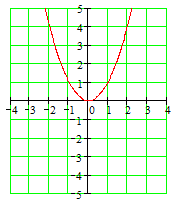 ii. \(~y=3x^2\)
\(x\) \(-2\) \(-1\) \(0\) \(1\) \(2\) \(y\) \(\hphantom{0000}\) \(\hphantom{0000}\) \(\hphantom{0000}\) \(\hphantom{0000}\) \(\hphantom{0000}\) 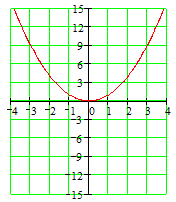
-
Compare each graph to the basic parabola, \(y=x^2\text{.}\) How is it different?
Activity 3.3.2. Graphing Practice II.
-
Complete the table of values, then sketch the graph on the grid with the basic parabola and label the coordinates of three points on the graph.i. \(~y=x^2 - 9\)
\(x\) \(-4\) \(-3\) \(-1\) \(0\) \(1\) \(0\) \(1\) \(y\) \(\hphantom{000}\) \(\hphantom{000}\) \(\hphantom{000}\) \(\hphantom{000}\) \(\hphantom{000}\) \(\hphantom{000}\) \(\hphantom{000}\) 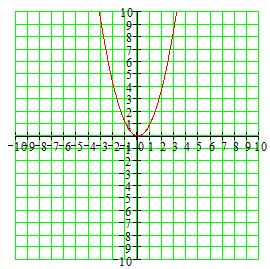 ii. \(~y=9 - x^2\)
\(x\) \(-4\) \(-3\) \(-1\) \(0\) \(1\) \(0\) \(1\) \(y\) \(\hphantom{000}\) \(\hphantom{000}\) \(\hphantom{000}\) \(\hphantom{000}\) \(\hphantom{000}\) \(\hphantom{000}\) \(\hphantom{000}\)
-
Find the \(x\)-intercepts of each graph.Find the vertex of each graph.
-
Compare each graph to the basic parabola, \(y=x^2\text{.}\) How is it different?
Activity 3.3.3. Graphing Practice III.
-
Complete the table of values, then sketch the graph on the grid with the basic parabola and label the coordinates of three points on the graph.i. \(~y=x^2 + 6x\)
\(x\) \(-6\) \(-4\) \(-3\) \(-2\) \(0\) \(1\) \(y\) \(\hphantom{000}\) \(\hphantom{000}\) \(\hphantom{000}\) \(\hphantom{000}\) \(\hphantom{000}\) \(\hphantom{000}\)
ii. \(~y=2x^2 - 6x\)\(x\) \(-1\) \(0\) \(1\) \(\frac{3}{2}\) \(2\) \(3\) \(4\) \(y\) \(\hphantom{000}\) \(\hphantom{000}\) \(\hphantom{000}\) \(\hphantom{000}\) \(\hphantom{000}\) \(\hphantom{000}\) \(\hphantom{000}\)
-
Find the \(x\)-intercepts of each graph.Find the vertex of each graph.
- Compare each graph to the basic parabola, \(y=x^2\text{.}\) How is it different?
Activity 3.3.4. Intercepts and Vertex.
- How do we find the \(y\)-intercept of a parabola from its equation?
- How do we find the \(x\)-intercepts of a parabola from its equation?
- Recall that to find the average of two numbers we add them up, and divide the result by 2.
- If the \(x\)-intercepts of a parabola are \(x=p\) and \(x=q\text{,}\) what is the \(x\)-coordinate of its vertex?
- If the \(x\)-intercepts of a parabola are \(x=0\) and \(x=\dfrac{-b}{a}\text{,}\) what is the \(x\)-coordinate of its vertex?
-
How do we find the \(y\)-coordinate of the vertex from the equation?
-
Describe how each of the three parameters \(a\text{,}\) \(b\text{,}\) and \(c\) affect the graph of the basic parabola.
- \(\displaystyle y=ax^2\)
- \(\displaystyle y=x^2 + c\)
- \(\displaystyle y=x^2 + bx\)
Subsection 3.3.1 Check Your Understanding
- What are the \(x\)-intercepts of the graph of \(~y=x^2-16\text{?}\) What are the \(x\)-intercepts of the graph of \(y=x^2-16x\text{?}\)
- What is the axis of symmetry of the graph of \(y=x^2-16\text{?}\) What is the axis of symmetry of the graph of \(~y=x^2-16\text{?}\)
- How is the graph of \(~y=2x^2+5~\) different from the basic parabola? What are the coordinates of its vertex?
- Compare the graphs of \(y=x^2-25\) and \(y=25-x^2\text{.}\)
Subsection 3.3.2 Wrap Up
In this Lesson, we worked on the following skills and goals related to quadratic models:
- Describe the effect of each of the parameters \(a\text{,}\) \(b\text{,}\) and \(c\) on the graph of a parabola
- Find the \(x\)- and \(y\)-intercepts of a parabola
- Find the vertex of a parabola
- Sketch the graph of a parabola
Subsection 3.3.3 Questions for Writing or Discussion
- Describe what the parameter \(a\) tells you about the graph of \(y=ax^2\text{.}\)
- Explain why the \(x\)-coordinate of the vertex is the average of the \(x\)-intercepts of the graph.
- Describe the differences between the graphs of \(y=x^2-4\) and \(y=x^2-4x\text{.}\)
- Explain why the graph of \(y=x^2-2\) is shifted down 2 units compared to the basic parabola.
Concept Questions.
-
Which point on a parabola always lies on the axis of symmetry?
- The \(x\)-intercept
- The \(y\)-intercept
- The vertex
- The origin
-
The \(x\)-intercept of the graph of \(~y=ax^2+bx+c~\) is the same as the value of which parameter?
- \(\displaystyle a\)
- \(\displaystyle b\)
- \(\displaystyle c\)
- None of these
-
What does the value of \(a\) tell us about the graph of \(~y=ax^2+bx+c~\text{?}\)
- The \(y\)-intercept
- The number of \(x\)-intercepts
- The \(x\)-coordinate of the vertex
- The width of the parabola
-
Give the equation of a parabola that has no \(x\)-intercepts.
- \(\displaystyle y=x^2\)
- \(\displaystyle y=x^2+4\)
- \(\displaystyle y=x^2-4\)
- \(\displaystyle y=x^2+x\)

