In this Lesson we review the quadratic formula, discuss the discriminant and the number of \(x\)-intercepts of the graph, and consider more examples of the standard applications of quadratic models.
Begin by trying to eradicate the erroneous version of the quadratic formula, \(x=-b \pm \dfrac{\sqrt{b^2-4ac}}{2a}\text{.}\) Also point out the distinction between a quadratic equation and the quadratic formula. The treatment of \(x\)-intercepts in the reading is a nice way to illustrate the quadratic formula and lead into the discriminant. Note that we do not treat complex numbers yet, other than to acknowledge their existence. (Some students already know about complex numbers, so it is best to mention briefly, but postpone further discussion for later.)
If you have time, go over Example 4.17 or Exercise 4.18 with the class, as they find solving formulas difficult.
Activity4.1.1.A Quadratic Model: Free-Fall.
A skydiver jumps out of an airplane at 11,000 feet. While she is in free-fall, her altitude in feet \(t\) seconds after jumping is given by
Use technology to complete the table of values. (You can use the Table feature of your technology tool.)
\(t\)
0
5
10
15
20
25
30
\(h\)
\(\hphantom{00000000}\)
\(\hphantom{00000000}\)
\(\hphantom{00000000}\)
\(\hphantom{00000000}\)
\(\hphantom{00000000}\)
\(\hphantom{00000000}\)
\(\hphantom{00000000}\)
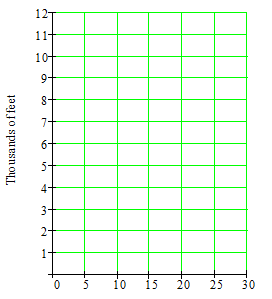
Graph the equation.
Write and solve an equation to answer the question: If the skydiver must open her parachute at an altitude of 1000 feet, how long can she free-fall?
Locate the corresponding point on your graph.
Activity4.1.2.Area and Perimeter.
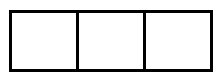
A dog trainer has 100 meters of chain link fence. She wants to enclose a total area of 250 square meters in three pens of equal size, as shown at right. We will find the length and width of each pen.
Let \(l\) and \(w\) represent the length and width of each pen. Label the figure. (How many \(l\)’s and \(w\)’s do you have?)
Write an equation in \(l\) and \(w\) about the amount of chain link fence. (Hint: Is this an area or a perimeter?)
Solve your equation for \(l\) in terms of \(w\text{.}\)
Write an equation in terms of \(l\) and \(w\) for the total area enclosed.
Substitute your expression for \(l\) from part (c) into your equation from part (d).
Solve your equation from part (d). (There are two solutions!)
Find the dimensions of each pen. Round your answers to hundredths. ("Dimensions" means length and width. There are two different solutions to the problem.)
List four algebraic methods for solving quadratic equations.
Which method(s) work on any quadratic equation?
Which method is fastest if one side of the equation is a perfect square?
For each equation, name the easiest method for solving, then solve.
\(\displaystyle x^2-7=0\)
\(\displaystyle x^2=7x\)
\(\displaystyle x^2-7x=8\)
\(\displaystyle (x-7)^2=8\)
\(\displaystyle x^2=7x-8\)
\(\displaystyle x^2-8x=4\)
Activity4.1.4.Deriving the Quadratic Formula.
Use completing the square to solve the equation \(x^2+bx+c=0\) for \(x\) in terms of \(b\) and \(c\text{.}\) Follow the steps below:
Move the constant term to the right side
Complete the square on the left side.
Write the left side as a perfect square; simplify the right side.
Extract roots.
Use completing the square to solve \(ax^2+bx+c=0\) for \(x\) in terms of \(a,~b\text{,}\) and \(c\text{.}\) Follow the steps below:
Move the constant term to the right side; divide both sides by the lead coefficient.
Complete the square on the left side.
Write the left side as a perfect square; simplify the right side.
Extract roots.
Subsection4.1.1Check Your Understanding
In Activity 1c, what value did you substitute for \(c\text{?}\) Why? When is \(h=11,000\text{?}\)
In Activity 2, did you solve an equation about area or about perimeter to find the values of \(w\text{?}\) How did you use the other quantity in your solution?
In Activity 2f, you found two solutions to the equation. Are these values the dimensions of each pen?
In Activity 4, what was different about the procedure in part (a) from the procedure in part (b)?
Subsection4.1.2Wrap Up
In this Lesson, we worked on the following skills and goals related to quadratic models:
Use the quadratic formula to solve quadratic equations
Solve quadratic equations for one variable in terms of the others
Solve problems arising from quadratic models
Subsection4.1.3Questions for Writing or Discussion
Explain in words how to evaluate the quadratic formula.
Explain what the discriminant tells us about a quadratic equation.
Use completing the square to derive the quadratic formula.
What is a solution of multiplicity two?
Concept Questions.
What is wrong with this statement of the quadratic formula?
Nothing
We should simplify the radical.
\(-b\) should be over \(2a\text{.}\)
It should be \(\pm b\)
Does \(~\sqrt{b^2-4ac} = b - \sqrt{4ac}\text{?}\) Why or why not?
No, it should be \(~b - 2\sqrt{ac}\text{.}\)
Yes, we take the square root of each term.
No, we cannot take the square root of a negative number.
No, \(~\sqrt{x+y} \not= \sqrt{x} + \sqrt{y}.\)
If a parabola opens downward and has no \(x\)-intercepts, what can you say about the vertex?
Its \(x\)-coordinate is positive.
Its \(y\)-coordinate is positive.
Its \(x\)-coordinate is negative.
Its \(y\)-coordinate is negative.
The graph of a quadratic equation has no \(x\)-intercepts if its discriminant is