In this Lesson we find the intercepts of a linear model, and interpret their meaning in the context of the model. Some students will have forgotten how to find the intercepts, and most will need help interpreting the meaning of the intercepts in context. A common mistake is to give the meaning of the variable on the appropriate axis, instead of its value at the intercept.
We also review the intercept method for graphing a line. Finally, we consider linear models given in the general linear form, \(~Ax+By=C\text{.}\)
Activity1.3.1.Interpreting the Intercepts.
Copper is the third most widely used metal, behind iron and aluminum. In 2007 the US Geological Survey estimated that there are 490 million tons of usable copper reserves left in the world. The global consumption of copper in 2007 was 17.8 million tons per year.
Complete the table of values.
Year
2008
2010
2015
2020
\(t~\)
\(\hphantom{00000}\)
\(\hphantom{00000}\)
\(\hphantom{00000}\)
\(\hphantom{00000}\)
\(C~\)
\(\hphantom{00000}\)
\(\hphantom{00000}\)
\(\hphantom{00000}\)
\(\hphantom{00000}\)
Supposing that we continue to consume copper at the same annual rate, write an equation for the amount of copper, \(C\text{,}\) in millions of tons, remaining \(t\) years after 2007.
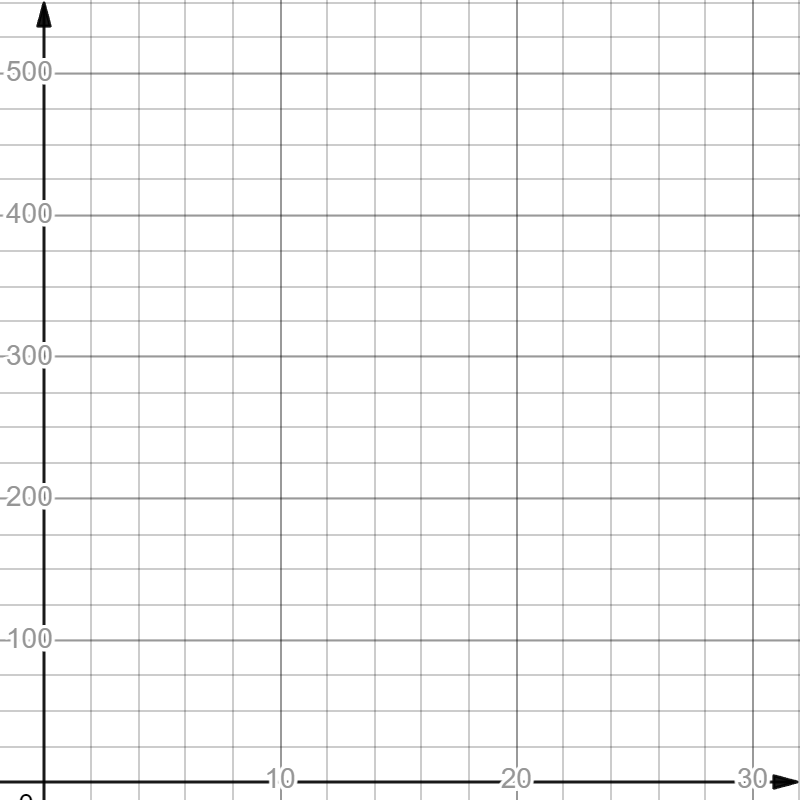
Graph the equation.
Use algebra to find the coordinates of each intercept of the graph.
\(t~\)
\(C~\)
\(0\)
\(\hphantom{00000}\)
\(\hphantom{00000}\)
\(0\)
Explain what the intercepts tell us about copper consumption.
The \(C\)-intercept is . It tells us:
The \(t\)-intercept is . It tells us:
Activity1.3.2.General Form for a Linear Equation, \(~Ax + By = C\).
The owner of a gas station has $19,200 to spend on unleaded gas this month. Regular unleaded costs him $2.40 per gallon, and premium unleaded costs $3.20 per gallon.
Write algebraic expressions to answer the questions:
How much do \(x\) gallons of regular cost?
How much do \(y\) gallons of premium cost?
Write an equation that relates the amount of regular unleaded gasoline, \(x\text{,}\) and the amount of premium unleaded, \(y\text{,}\) that the owner can buy if he spends $19,200.
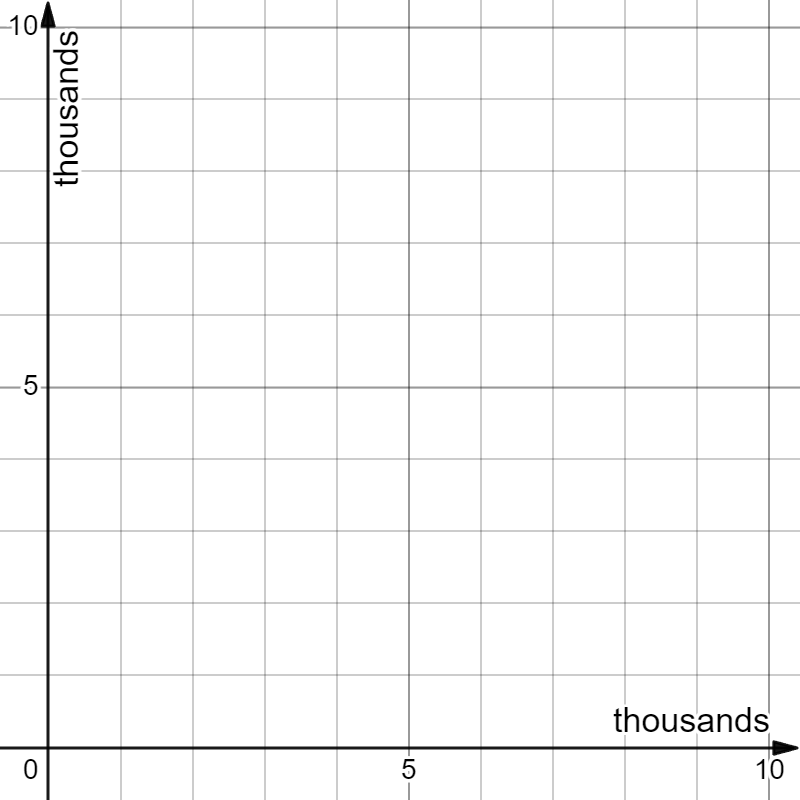
Find the intercepts and use the intercept method to sketch the graph.
\(x~\)
\(y~\)
\(0\)
\(\hphantom{00000}\)
\(\hphantom{00000}\)
\(0\)
Explain what the intercepts tell us about the amount of gasoline.
The \(x\)-intercept is . It tells us:
The \(y\)-intercept is . It tells us:
If the gas station owner would like to buy 5000 gallons of regular gasoline, how many gallons of premium can he buy with his budget ot $19,200? Label this point on the graph.
What is the meaning of the point \((2000, 4500)\) on the graph?
Subsection1.3.1Check Your Understanding
In Activity 1, how did you use algebra to find the intercepts of the graph?
In Activity 1, which intercept gives the starting value of \(C\text{?}\)
The equation you wrote in Activity 2 was different in form from the equation you wrote in Activity 1. How?
In Activity 2, what did the variables \(x\) and \(y\) represent?
Subsection1.3.2Wrap-Up
In this Lesson, we worked on the following skills and goals related to linear models:
Find the intercepts of the graph of a linear equation.
Interpret the intercepts of the graph of a linear model.
Write a model in general linear form, \(Ax+By=C\text{.}\)
Graph a line by the intercept method.
Solve a linear equation for \(y\) in terms of \(x\text{.}\)
Subsection1.3.3Questions for Writing or Discussion
Explain how to graph a line by the intercept method.
Explain how the words intercept and intersect are related, and how they are different.
In what situations is the general linear form easier to use for a model than the form \(y = \text{(starting value)} + \text{rate} \cdot x\text{?}\)
Explain why setting \(y=0\) in a linear equation allows us to find the \(x\)-intercept.
Concept Questions.
Suppose a line is increasing and its \(y\)-intercept is positive. Which is true:
Its \(x\)-intercept is positive.
Its \(x\)-intercept is negative.
We can’t tell.
The line may not have an \(x\)-intercept.
Is it possible for the \(x\)-intercept and the \(y\)-intercept of a line to be the same point?
No
Yes
Only for a vertical line
They are always the same point.
What is the \(y\)-coordinate of any point on the \(x\)-axis?
\(\displaystyle (x,y)\)
\(\displaystyle Y\)
It depends on the value of \(x\text{.}\)
\(\displaystyle 0\)
Delbert says that the intercepts of the line \(~3x+5y=30~\) are \((10,6)\text{.}\) What is wrong with his answer?